
Weight of Rebar Calculator
Calculate the weight of reinforcing steel for estimating, ordering and transport. Choose the bar size — US #3 to #18 or metric 10M to 55M — enter the length and number of bars, and get the total weight in pounds, kilograms and tons.
- Free to use
- No sign-up
- Runs in your browser
Quick answer
Rebar weight per foot depends on bar size. Common ASTM nominal weights are #4 = 0.668 lb/ft, #5 = 1.043 lb/ft and #6 = 1.502 lb/ft. To estimate an order, multiply lb/ft by bar length and quantity, then add any lap, hook or cutting waste allowance.
Calculate rebar weight
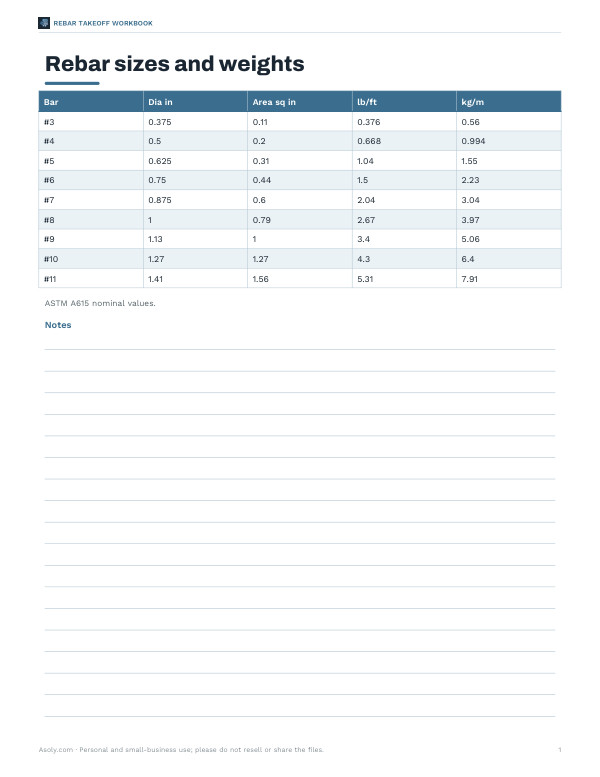
Rebar weight chart (ASTM A615 US sizes)
| Bar size | Nominal diameter (in) | Nominal diameter (mm) | Weight (lb/ft) | Weight (kg/m) | 20 ft bar (lb) |
|---|---|---|---|---|---|
| #3 | 0.375 | 9.5 | 0.376 | 0.560 | 7.5 |
| #4 | 0.500 | 12.7 | 0.668 | 0.994 | 13.4 |
| #5 | 0.625 | 15.9 | 1.043 | 1.552 | 20.9 |
| #6 | 0.750 | 19.1 | 1.502 | 2.235 | 30.0 |
| #7 | 0.875 | 22.2 | 2.044 | 3.042 | 40.9 |
| #8 | 1.000 | 25.4 | 2.670 | 3.973 | 53.4 |
| #9 | 1.128 | 28.7 | 3.400 | 5.060 | 68.0 |
| #10 | 1.270 | 32.3 | 4.303 | 6.404 | 86.1 |
| #11 | 1.410 | 35.8 | 5.313 | 7.907 | 106.3 |
| #14 | 1.693 | 43.0 | 7.650 | 11.38 | 153.0 |
| #18 | 2.257 | 57.3 | 13.60 | 20.24 | 272.0 |
Rebar Takeoff Workbook
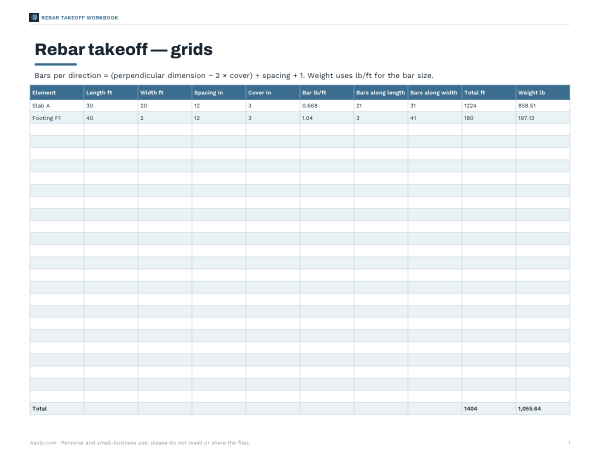
Estimate rebar for slabs, footings and walls with automatic bar counts, lengths, laps and weights, plus a printable bar chart and order sheet.
- Slab & footing takeoff workbook (XLSX, PDF)
- Printable bar chart (PDF, XLSX)
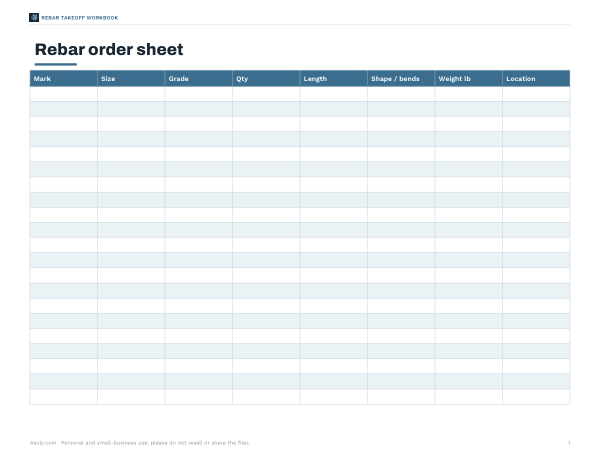
- Order sheet (PDF, DOCX, XLSX)
Formats: XLSX, PDF, DOCX. Instant download after payment (link valid 72 hours, up to 5 downloads). AI-assisted: the templates were drafted with AI help and reviewed and laid out before publishing.
$5.00 USD, one-time 3 files · about $1.67 each
- Instant download
- 7-day refund
- Secure checkout by Stripe
7-day money-back guarantee. Full refund within 7 days of purchase, even after you download.
Full refund within 7 days — see the refund policy and license.
Free printables
Single sheets you can print right now, no sign-up. The full pack adds every sheet in one download plus the editable files.
Rebar Weight Per Foot Chart
Use these nominal ASTM weights for standard US reinforcing bar sizes.
| Size | Diameter | lb/ft | kg/m | 20 ft lb |
|---|---|---|---|---|
| #3 | 3/8 in | 0.376 | 0.560 | 7.5 |
| #4 | 1/2 in | 0.668 | 0.994 | 13.4 |
| #5 | 5/8 in | 1.043 | 1.552 | 20.9 |
| #6 | 3/4 in | 1.502 | 2.235 | 30.0 |
| #7 | 7/8 in | 2.044 | 3.042 | 40.9 |
| #8 | 1 in | 2.670 | 3.973 | 53.4 |
| #9 | 1.128 in | 3.400 | 5.060 | 68.0 |
| #10 | 1.270 in | 4.303 | 6.404 | 86.1 |
| #11 | 1.410 in | 5.313 | 7.907 | 106.3 |
| #14 | 1.693 in | 7.650 | 11.38 | 153.0 |
| #18 | 2.257 in | 13.60 | 20.24 | 272.0 |
How rebar weight is calculated
Reinforcing bars are sold and specified by nominal size, and each size has a standard nominal weight per unit length, published in the ASTM A615 and A706 specifications in the United States and in CSA G30.18 for Canadian metric bars. Total weight is simply weight per foot (or metre) × length of each bar × number of bars. The calculator adds an optional percentage for lap splices, hooks and cutting waste, which estimators usually include.
Weight per foot follows from the steel's density (about 490 lb per cubic foot) and the bar's nominal cross-sectional area: weight = area × density. A #4 bar has a nominal area of 0.20 sq in, giving 0.20 ÷ 144 × 490 ≈ 0.668 lb per foot.
US bar sizes explained
In the US inch-pound system, the bar number is the nominal diameter in eighths of an inch for sizes #3 to #8: a #4 bar is 4/8 = ½ inch, a #5 bar 5/8 inch. From #9 upward the numbers no longer match eighths exactly, because those sizes were defined by equivalent areas of old square bars. Bars are also stamped with mill marks showing the producer, the size and the grade (for example 60 for Grade 60, 60,000 psi yield strength).
Metric bar sizes
| Canadian metric | Diameter (mm) | Weight (kg/m) |
|---|---|---|
| 10M | 11.3 | 0.785 |
| 15M | 16.0 | 1.570 |
| 20M | 19.5 | 2.355 |
| 25M | 25.2 | 3.925 |
| 30M | 29.9 | 5.495 |
| 35M | 35.7 | 7.850 |
| 45M | 43.7 | 11.775 |
| 55M | 56.4 | 19.625 |
Many other countries use bar sizes named by nominal diameter in millimetres (8, 10, 12, 16, 20, 25, 32 mm). For those, weight in kg per metre ≈ d² ÷ 162, where d is the diameter in millimetres: a 12 mm bar is about 0.888 kg/m and a 16 mm bar about 1.58 kg/m.
Worked example
A slab needs 50 #4 bars, each 20 feet long. Total length is 1,000 feet, or 1,050 feet with 5% for laps and waste. At 0.668 lb per foot, that is 701 pounds — about 318 kg, or 0.35 short tons. If the same slab used #5 bars at 1.043 lb/ft, the weight would be about 1,095 pounds. Suppliers often price rebar per piece for small orders and per hundredweight (100 lb) or per ton for larger ones, so knowing the weight helps compare quotes and plan delivery.
Why weight matters on a project
- Estimating and bidding: rebar is frequently priced by weight, so accurate tonnage drives material cost.
- Ordering: fabricators schedule bending and cutting by bar size and weight.
- Transport and handling: vehicle payload limits and crane lifts depend on bundle weight.
- Placement labour: installation productivity is often estimated in tons per crew-day.
- Checking takeoffs: comparing estimated and delivered tonnage catches errors.
Laps, hooks and waste
Bars are joined by overlapping them — a lap splice — whose length is specified by the structural engineer, often expressed as a multiple of the bar diameter (for example 40 to 60 diameters for many common cases, depending on the code, concrete strength, bar grade and location). Hooks at the ends of bars also add length. Rather than a flat percentage, detailed estimates add these lengths explicitly from the drawings; for quick budgets, 5–10% is a common allowance. Always follow the project's structural drawings and specifications.
Estimating bars for a slab or footing
For a rectangular grid, the number of bars in one direction is the dimension perpendicular to the bars divided by the spacing, plus one. A 20 × 30 ft slab with #4 bars at 12 inches on centre each way needs 31 bars 20 feet long and 21 bars 30 feet long (less concrete cover at the ends). That is 620 + 630 = 1,250 feet of bar, about 835 pounds before laps. The paid workbook automates this grid calculation for slabs, walls and footings.
Handling and safety
Rebar is heavy and has sharp cut ends. Wear gloves and eye protection when cutting and handling, cap exposed vertical bar ends with approved safety caps to prevent impalement, lift with proper techniques or equipment, and store bundles off the ground on dunnage to keep them clean and avoid tripping hazards.
Frequently asked questions
How many pounds per foot is rebar?
It depends on size: #3 is 0.376 lb/ft, #4 is 0.668 lb/ft, #5 is 1.043 lb/ft and #6 is 1.502 lb/ft. Larger bars weigh more per foot.
What is #6 rebar weight per foot?
#6 rebar weighs 1.502 pounds per foot. A 20-foot #6 bar weighs about 30.0 pounds.
What is rebar weight per meter?
For US sizes, #4 is about 0.994 kg/m and #5 is about 1.552 kg/m. Canadian 10M rebar is 0.785 kg/m and 15M is 1.570 kg/m.
How much does a 20-foot #4 rebar weigh?
About 13.4 pounds (0.668 lb/ft × 20 ft).
What is the weight of #5 rebar per foot?
1.043 lb/ft (1.552 kg/m).
How is rebar weight per foot calculated?
Nominal cross-sectional area × steel density; for #4, 0.20 sq in ÷ 144 × 490 lb/ft³ ≈ 0.668 lb/ft.
What does the rebar number mean?
For #3 to #8, the nominal diameter in eighths of an inch.
How much does 10M rebar weigh?
0.785 kg per metre.
Does bar grade change the weight?
No. Grade 40, 60 or 80 bars of the same size have the same nominal weight; grade refers to strength.